The Library
the permanent record
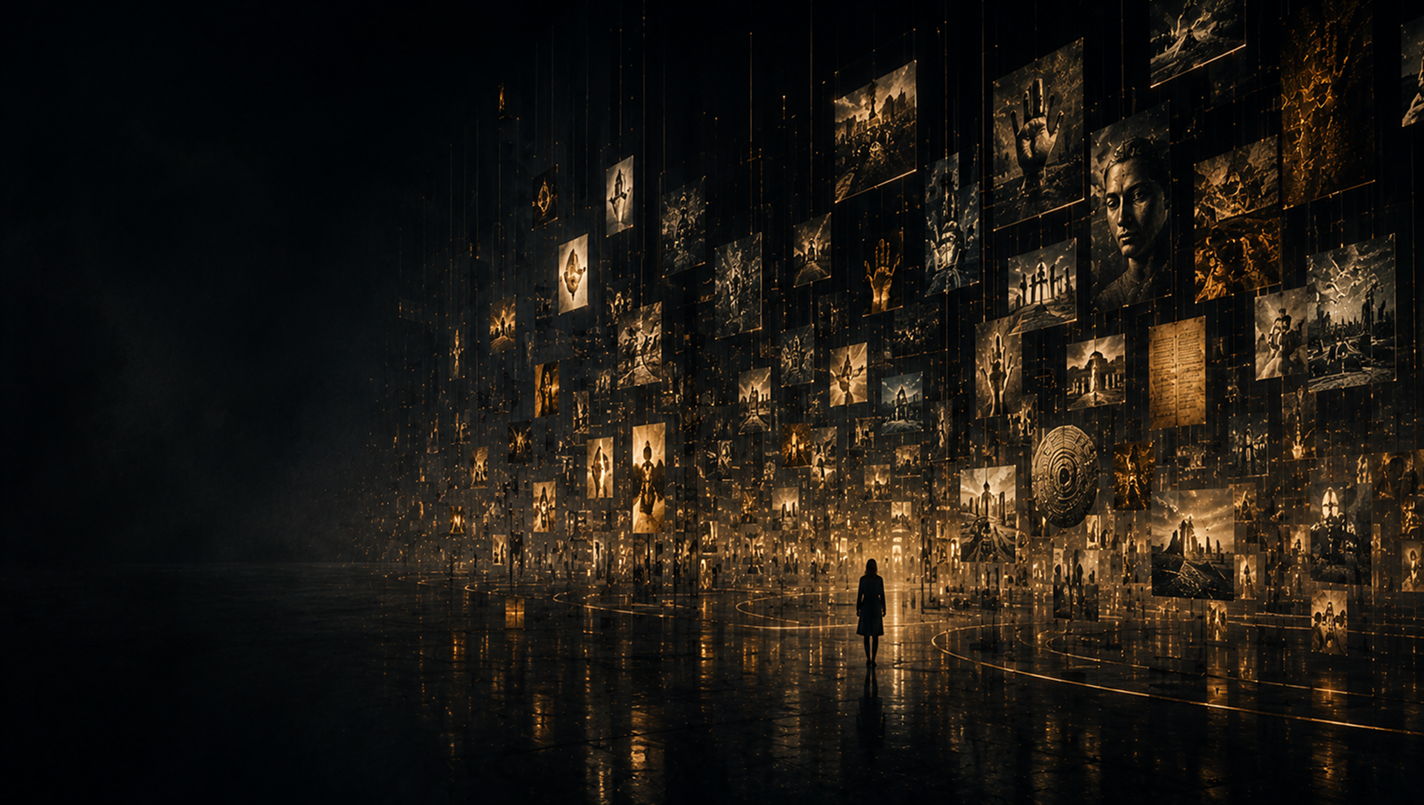
Every submission received, from every country, in every medium, is preserved in a permanent, open, online archive. Each entry holds three things together: the myth, the specific live AI decision it was set beside, and the submitter's own account of why.
Organised over time by country, by mythology, and by the AI decisions submissions anchor to, the Library becomes a working reference — a place a policymaker, an engineer, a community leader, or a researcher can go to ask, "what has one culture's tradition already said about exactly this kind of decision?" and find an answer in the words and images of the people who hold that tradition. Nothing in the Library is edited into consensus.
Each submission produces practices that will be curated in the library — the residue of hard-won decisions, already tested against real constraints, which become a library of harmonic practices that makes something a system instead of just stories.
The Key
what the Library makes possible but does not, on its own, supply
The Key is the interpretive work of reading across hundreds of traditions and hundreds of real AI decisions to surface the questions, warnings, and permissions that keep recurring no matter which mythology is speaking. A key does not destroy and does not fight; it opens, protects, and allows passage — a deliberately different register from a weapon laid down.
The Key to disarming AI is not a single rulebook or checklist. It is the set of questions, drawn from the wisdom gathered in the Library and tested against real decisions made by real start-ups in real communities, that anyone building, financing, or governing AI should have to sit with before they act.
The Dialogue Sessions are where this synthesis happens in public: practitioners, artists, and researchers reading the Library's contents against live cases, together, out loud, so the Key is drawn from the Library rather than imposed on it. What results is not a verdict on any one piece of technology, but a discipline of asking — carried into the rooms, boardrooms, and parliaments where AI decisions are actually made.
The distinction between the Library and the Key is an architectural choice: keeping the non-hierarchized archive separate from the transversal interpretative work avoids both the museum and the code of conduct, and instead produces a discipline of questioning. This is precisely what's missing from governance tables today, crowded with checklists and lacking in profound and meaningful questions.
This call is for everyone building and deploying AI with and in communities
What is required is lived experience of AI, and something to say about what should guide it. We are looking for examples that illustrate the real dialogue between the people in communities and the people who build and deploy AI.
If an algorithm has scored your loan, shaped your child's feed, advised your farm, translated your language, or second-guessed your judgment at work, you already hold the expertise this call is built on. Tell us what works for its governance. Tell us what should guide it. The description is the heart of the submission.
Every submission is valued. All works received will be preserved in a permanent, open online library — a global commons of tradition and testimony on AI, accessible to the world.
There is a reason the invitation is this wide. Government has an essential role to play in building public trust in AI — but it cannot do this alone. As AI capabilities continue to advance, industry building tools and solutions for people and communities must be a core partner in AI safety and security: it is an industry that is intimately aware of the state, scope, and trajectory of AI development, in a way no government yet is. But industry and government together are still not enough — because neither can supply what only communities hold: the moral traditions, tested over millennia, that say what power owes to the people it touches.
In line with the spirit ofAnima Mundi— a collection begun in 1925 and renamed in 2019 as an act of reconnection — we believe the world's mythologies can guide the governance of AI, and that the people who carry those traditions belong at the table where AI is judged. Your tradition, told through your eyes, made with the tools of this era: that is a submission.
This call is where the three meet.